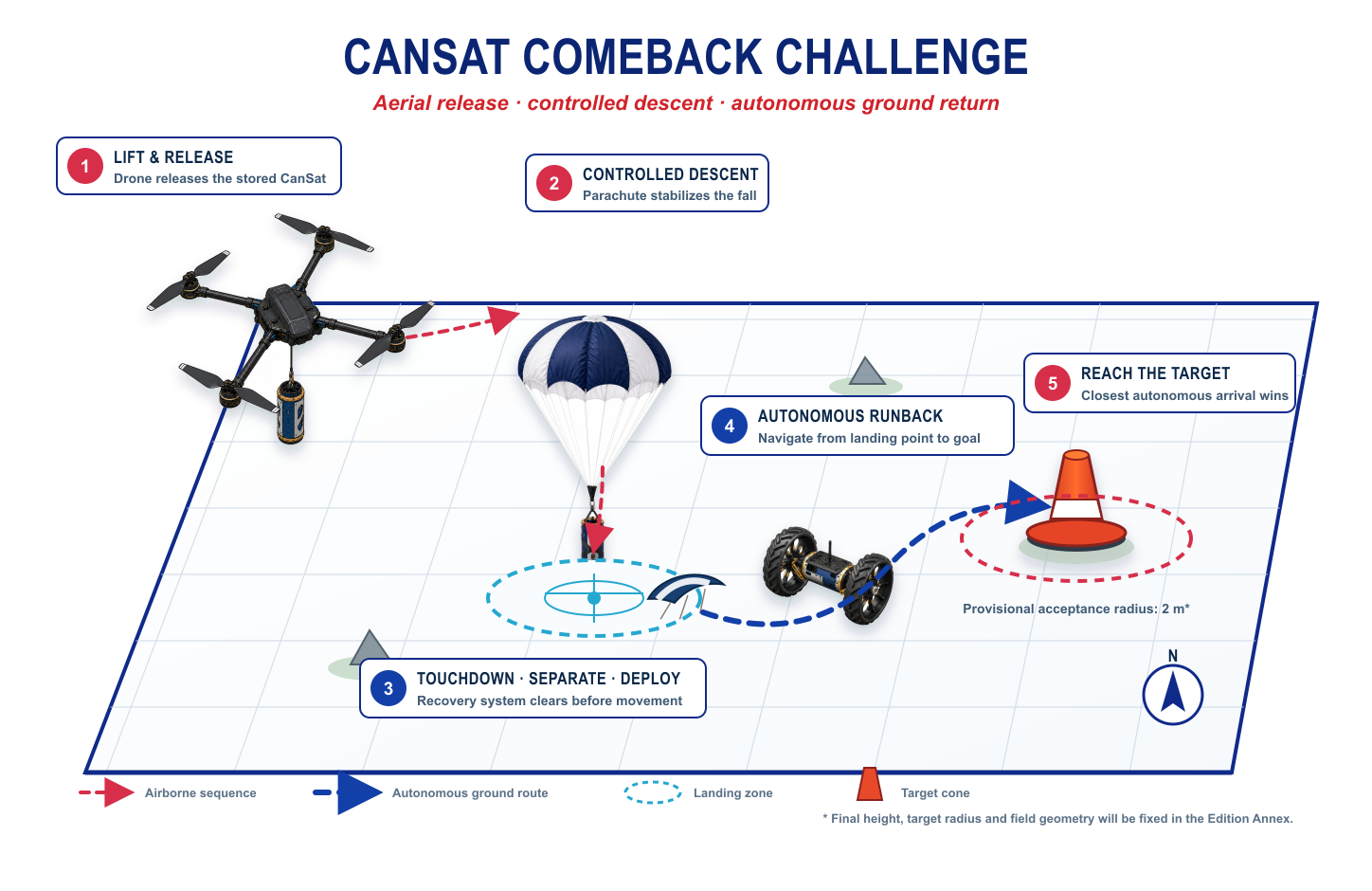
Lift and release
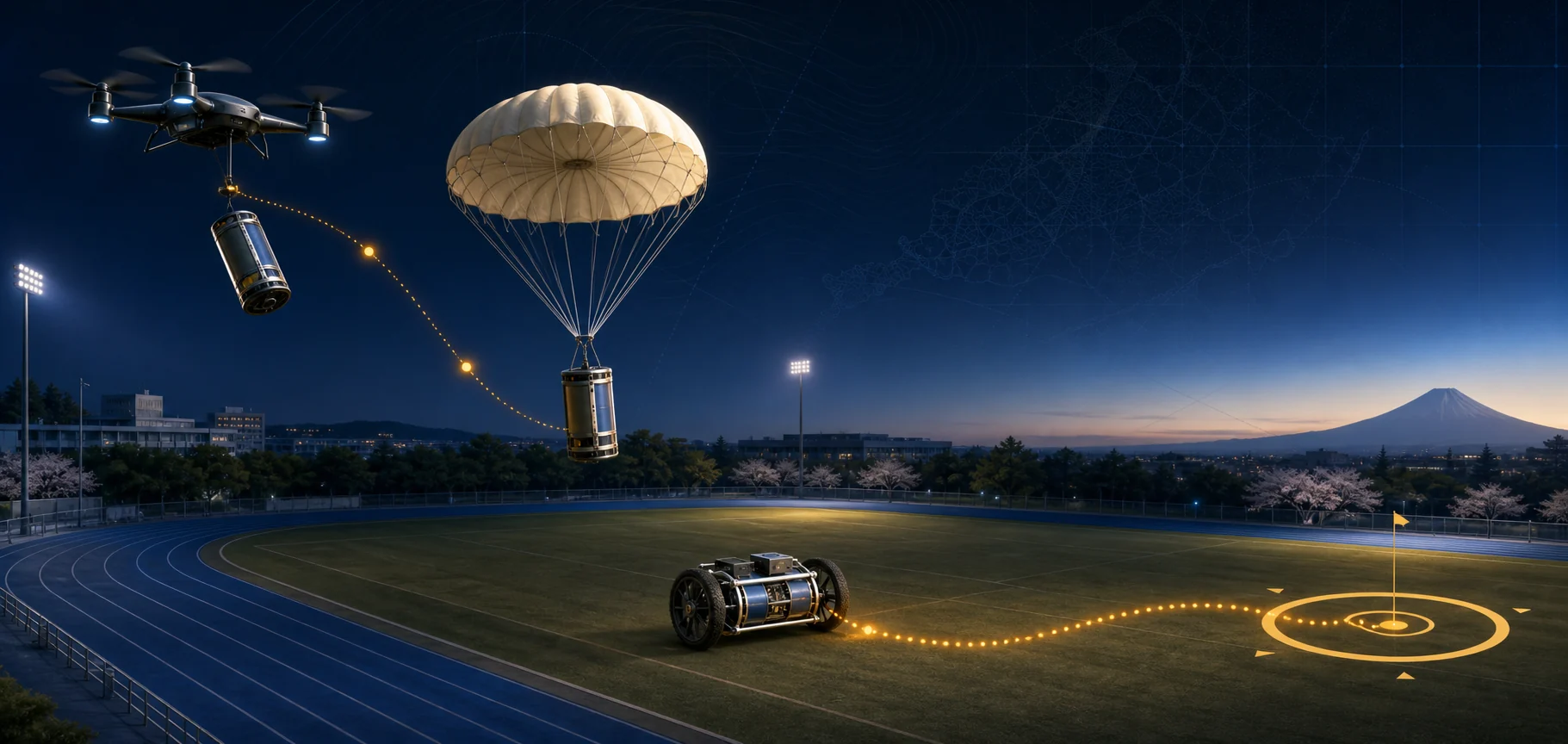
The organizer-operated drone carries and releases the stored CanSat.
Release. Land. Return.
A compact autonomous recovery challenge in which a CanSat is released by an organizer-operated drone, descends and lands, then travels on the ground toward a designated return target.
The Comeback Challenge is independent of the Multi-Domain Robotics Challenge. Teams may follow the competition that best matches their engineering interests.
The CanSat Comeback Challenge focuses on the complete recovery sequence rather than flight alone. Teams design a compact system that survives release and descent, confirms landing and then begins a terrestrial return toward the assigned target.
The final sequence, release conditions and scoring will be confirmed in the official rulebook.
 Full-size map
The organizer-operated drone carries and releases the stored CanSat.
The recovery system stabilizes the CanSat during descent.
After landing, the CanSat separates from its recovery system and prepares for ground movement.
The CanSat navigates on the ground from the landing point toward the goal.
Performance is evaluated from the autonomous arrival relative to the designated target.
The final rulebook will define accepted configurations and technical limits. The current design direction is intentionally open to more than one mobility concept.
Compact two-wheel or self-balancing architectures may offer a simple and lightweight approach.
Additional wheels or tracks may improve stability and terrain handling after landing.
Other justified ground-mobility solutions may be considered when consistent with the final rules.
The official rulebook, technical limits, venue conditions, release height, course layout, scoring and registration procedure will be published after committee and venue review. No competition rulebook is available for download yet.